

Climate risk · Adaptation · Resilience
When climate risk shows up in your renewal, your loan terms, or your supply — start here.
Think Resilience helps small and mid-sized companies understand physical climate risk, identify practical resilience actions, and turn insurer, lender and buyer requests into evidence they can use.
One quality standard · Internationally applicable
Climate risk and adaptation support for businesses with real assets and real operating constraints.

Think Resilience is a climate risk and adaptation advisory working with businesses and partners internationally. Our focus is practical: buildings, equipment, operations, supply chains, financing requirements and the decisions needed to keep a business working as physical climate risks change.
Start where you were asked
Three climate-risk questions that reach your desk
Each one asks a different question, and each one accepts a different kind of answer.
The insurer
“Evidence of resilience measures at the insured location.”
A renewal request or condition with a deadline. The insurer wants to understand the hazards affecting the site, measures already in place, and what the business plans to do next.
The lender
“How is physical climate risk managed across your sites?”
A due-diligence question about exposure, management response and business continuity. The answer may become part of the lender’s credit assessment.
The buyer
“Complete Section 4: climate adaptation.”
A customer or OEM questionnaire asking how you identify and manage climate-related disruption. The answer needs to be useful without committing the business to more than it can deliver.
The gap we work in
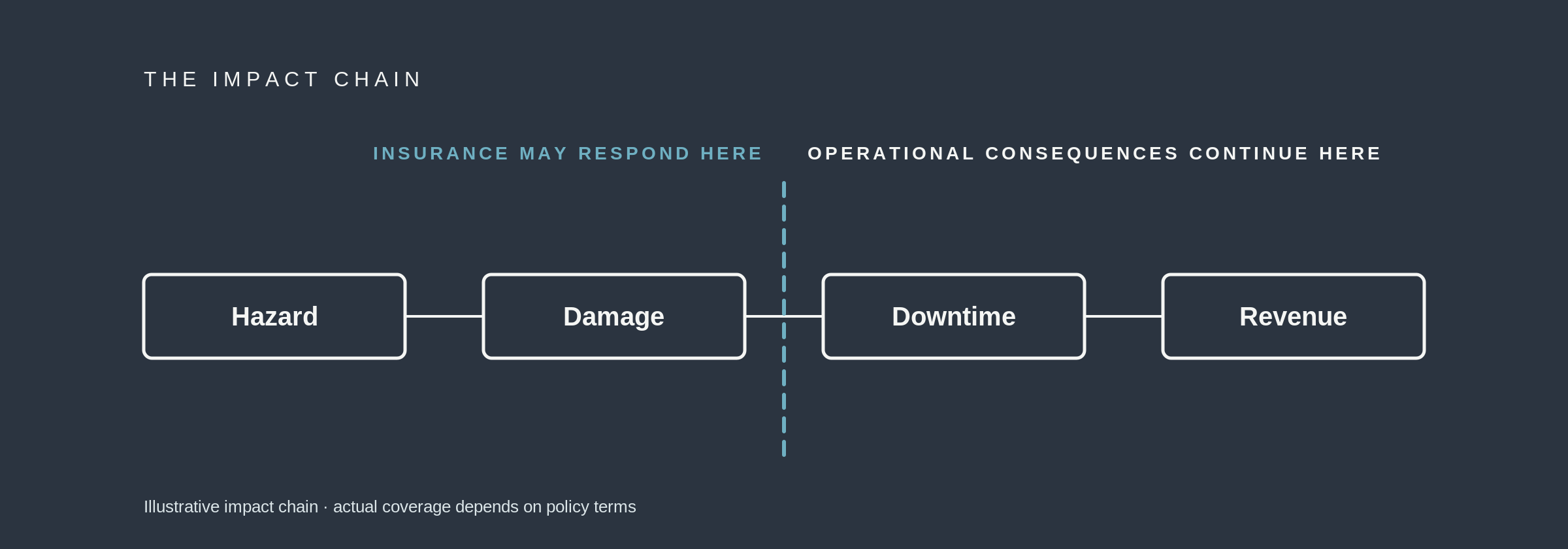
Insurance can transfer part of the loss. It does not remove the operational disruption.
An insurance policy may cover some financial consequences of an insured event. It does not prevent downtime, missed shipments, supplier disruption or customer impacts. We examine the operational exposure around the insured loss — and the resilience measures that can reduce it.
Three depths, one method
Start proportionate. Go deeper when the decision, exposure or standard requires it.
Depth 01Snapshot · Location hazard report
See the hazard picture first
From $S
1 session · 90 minutes · 1+ locations
Structured intake form capturing sites, assets and context
One Munich Re Location Risk Intelligence report per location
Interpretation of the hazard results in business terms
Findings presented in one 90-minute session
Depth 02Foundational · Physical climate risk screening
Screen one priority location first
From $A
5 sessions · 5 weeks · 1 location
✔ Physical climate risk screening across 12 hazards
✔ A short, prioritized list of practical resilience actions
✔ A one-page evidence summary for external conversations
Depth 03Comprehensive · Climate risk assessment & adaptation planning
Assess the risk & build the adaptation plan
From $C
3 milestones · 12 weeks · 1+ locations
Climate risk assessment structured to ISO 14091
Climate adaptation plan structured to ISO 14090
Adaptation pathways work informed by BS 8631
Independent external review included
Upgrade path: the full Snapshot fee credits against Foundational or Comprehensive within 90 days, or 40% within 12 months. Forty percent of the Foundational fee credits against Comprehensive within 12 months.
After handover · Optional · Separately priced · Available with every tierContinuing support
Investment ladders, coaching through the decisions, or a specialist on call through renewal season.
From $F/hr
ISO 14091 · ISO 14090 · BS 8631
Work structured with reference to recognized climate risk and adaptation standards. We describe the work as standards-aligned, not as certification of the client.
Munich Re hazard data
Location Risk Intelligence supports the location-level hazard screening.
Independent review
Full assessments receive independent external review before final delivery.
One accountable lead
Angie delivers and signs the work. You know who is responsible for the analysis.
Bring the letter you received.
Thirty minutes with Angie. We will look at what you were asked for, the deadline and the sites involved. You will leave knowing whether a snapshot or screening is enough, whether a full assessment is warranted, and what the next step would cost.